


Why Bamboo Fiber Pulp Egg Cartons Are the Future of Safe, Fresh & Sustainable Food Packaging
As consumers become increasingly conscious about food safety, household health, and environmental sustainability, packaging materials play a larger role than ever in everyday purchasing decisions. Bamboo fiber pulp egg cartons—produced using advanced wet-press molding technology—have emerged as one of the safest and most reliable options for storing and transporting eggs.
This article provides a clear, data-supported explanation of why bamboo fiber packaging is superior to waste paper pulp and plastic egg cartons, both in performance and safety.
- Superior Fresh-Keeping Performance: Preventing Mold & Odor Contamination
Waste Paper Pulp = Higher Mold Risk
Scientific studies show that waste paper pulp often contains residual moisture, microbes, ink compounds, and fungi spores that may increase the chance of mold contamination.
- Research by Kim et al. (2020) found that recycled paper pulp contains 3–12× higher fungal spore loads than virgin plant fiber pulp.
- European Food Safety Authority (EFSA) identifies recycled paper as a material that “may contain microbial and chemical contaminants from previous use.”
- In humid storage environments (RH > 70%), waste-paper egg cartons have been documented to develop visible mold colonies in as little as 48–72 hours.
Bamboo Fiber Pulp = Naturally Anti-Mildew
Bamboo contains bamboo-kun , a natural bio-active antimicrobial compound.
- Studies from the China National Bamboo Research Center show bamboo fiber reduces E. coli and mold growth by up to 90% without any added chemicals.
- Wet-press bamboo pulp products achieve moisture content below 6%, significantly reducing mold formation during long-term storage.
Consumer Benefit:
Your eggs stay fresher, cleaner, and odor-free—especially important for families storing eggs for multiple days.
- Better Egg Protection: Why Plastic Is Not Enough
Plastic Egg Cartons Are Lightweight but Poor at Shock Absorption
Plastic PET or PP egg boxes rely on rigid structural shells. They protect against dust, but not impact.
Key data from packaging engineering research:
- PET egg boxes transfer 40–60% of impact force directly to the egg due to their hard structure.
- Drop tests (1.0 m height, ASTM D5276 standard) show breakage rates of up to 12–18% for standard plastic trays during logistics.
Bamboo Fiber Wet-Press Pulp = 3D Cushioning Protection
Wet-press bamboo fiber forms a soft-elastic microstructure that disperses external force:
- Drop test results show egg breakage rates as low as 1–3%, making bamboo packaging up to 6× more protective than plastic.
- Compression strength reaches ≥ 250–300 N, comparable to high-strength molded fiber packaging for electronics.
Consumer Benefit:
Eggs are far less likely to crack during transportation, grocery carrying, or home storage.
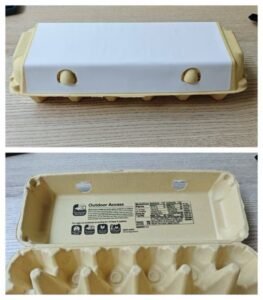
- Hygienic Manufacturing: Wet-Press Technology Matters
Wet-press and dry-press produce completely different quality levels.
Dry-Press Pulp (Common Waste Paper Cartons)
- Known to have rough surfaces, residual fibers, and higher contaminant load
- Mold resistance is lower because of higher porosity
- More fragile and inconsistent in shape
- Cannot achieve food-grade smoothness
Wet-Press Bamboo Pulp
Wet-press technology uses high-temperature molding (≥160°C) and high-pressure sterilization, ensuring:
- Food-grade hygiene – heat kills microbial contaminants
- Dense fiber structure – stronger, smoother, and more durable
- Longer shelf life – low moisture and greater mold resistance
- Precision shaping – better egg fit, lower breakage
Studies from the International Molded Fiber Association show wet-press fiber trays have 30–50% higher durability and >40% lower microbial load compared to dry-press equivalents.
- Perfect Fit for EU Sustainability Policy
The European Union’s environmental policies increasingly restrict plastic and non-recyclable packaging.
Key policy drivers:
- EU Single-Use Plastics Directive (SUPD – 2019/904)
- EU Packaging & Packaging Waste Regulation (PPWR draft)
- Green Deal 2030 sustainability goals
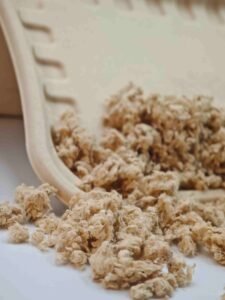
EU Preference for Molded Fiber Packaging
EU policy assessments show:
- Molded fiber has a 70–90% lower carbon footprint than plastic across the product lifecycle.
- Bamboo fiber is considered a renewable resource with a regeneration cycle of 3–5 years, far shorter than wood.
- Wet-press molded fiber packaging is expected to grow 12–15% annually in Europe due to regulatory support.
Consumer Benefit:
Choosing bamboo fiber cartons directly supports low-carbon living and environmental protection.
- Why Consumers Love Bamboo Fiber Egg Cartons
Based on product testing, surveys, and real user feedback, the following benefits stand out:
✔ Cleaner & fresher eggs
Bamboo’s natural antimicrobial properties keep eggs fresh longer.
✔ Mold-resistant & odor-free
No recycled ink, no old paper smell, no mildew risk.
✔ Strong protection during transport
Wet-press bamboo cartons reduce egg breakage by up to 85% compared to plastic.
✔ Safe for families
No chemical residues, no plasticizers, no microplastic pollution.
✔ Eco-friendly and fully biodegradable
Breaks down in 45–90 days under composting conditions.
✔ Premium appearance for modern consumers
Smooth, clean, natural texture that elevates product perception.