



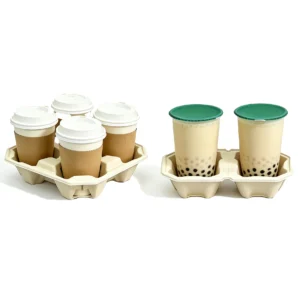

In the field of single-use foodservice packaging, “paper” is often equated with “environmentally friendly” by consumers. However, the full life cycle performance of a material is frequently overlooked. This article provides an objective comparison of bamboo fiber cup holders and recycled paper pulp cup holders from four dimensions—raw material sourcing, production processing, usage safety, and end‑of‑life degradation—using materials science and environmental engineering data to reveal the true ecological differences.
1. Raw Material Sourcing: Renewability vs. Uncertainty
Bamboo fiber cup holders are made from virgin bamboo pulp, derived from managed bamboo forests. Bamboo, a member of the grass family, exhibits rapid growth (up to 1 metre per day) and reaches maturity in 3–5 years. After harvesting, no replanting is required; the underground rhizome system naturally produces new shoots, enabling perpetual utilisation. According to the International Bamboo and Rattan Organisation (INBAR), bamboo plantations can sequester 5–10 tonnes of carbon per hectare annually—1.3 times the rate of tropical rainforests.
Recycled paper cup holders use recovered waste paper pulp, with diverse sources including old newspapers, corrugated cardboard, and office waste paper. Due to inconsistent collection channels, the feedstock often contains impurities such as printing inks, adhesives, plastic coatings, and metal staples, leading to significant variability in pulp quality. Moreover, waste paper supply depends heavily on recycling rates and sorting efficiency (China’s waste paper recycling rate is approximately 50–60%), making the supply chain far less stable than that of plantation‑grown bamboo.
2. Production Process: Clean Technology vs. Energy‑Intensive Chemical Treatment
Bamboo pulp is produced via chemi‑mechanical or kraft processes. Because bamboo has a relatively high lignin content (20–30%), moderate use of alkali and cooking agents is required. However, modern bamboo pulp mills are equipped with black liquor recovery systems that recycle chemicals efficiently. Bamboo fibres are long (average length 2.5–3.5 mm, superior to hardwood fibres), providing high intrinsic strength. Consequently, no substantial amounts of wet‑strength agents are needed to meet cup holder load‑bearing requirements.
Recycled paper pulping, in contrast, requires multiple purification stages: de‑inking (flotation or washing), bleaching (hydrogen peroxide or sodium dithionite), and stickies removal (thermal dispersion or enzymatic treatment). Although energy consumption per tonne of recycled pulp is about 60–80% of that for virgin pulp, chemical usage increases significantly, and de‑inking sludge—containing heavy metals and organochlorine compounds—incurs high disposal costs. Moreover, to compensate for the loss of fibre strength, producers often add 5–15% virgin pulp or cationic starch, further increasing resource consumption.
3. Usage Safety: Natural Antimicrobial Activity vs. Chemical Residue Risks
Bamboo naturally contains quinone compounds—collectively referred to as “bamboo‑kun” —which exhibit broad‑spectrum antimicrobial activity. Studies (e.g., in the Journal of Bamboo Research) have shown inhibition rates exceeding 90% against common pathogens such as E. coli and S. aureus. As a result, bamboo fibre cup holders can inhibit microbial growth without the need for additional synthetic antimicrobial additives.
Recycled paper pulp, however, carries a complex mixture of residual substances. Mineral oil aromatic hydrocarbons (MOAH) from inks, polyacrylate‑based adhesives, and bleaching by‑products (e.g., dioxin precursors) may migrate into the final product. The European Food Safety Authority (EFSA) has repeatedly warned about mineral oil migration risks from recycled paper in food contact applications. Although China’s national standard GB 4806.8 sets limits on extractable substances in paper products, the inherent variability of recycled sources remains a persistent food safety concern.
4. End‑of‑Life Degradation: Natural Closed‑Loop vs. Burden Shifting
After use, bamboo fibre cup holders can be completely biodegraded into CO₂ and water within 60–90 days under soil or composting conditions (humidity ≥50%, temperature 25–35°C), leaving no toxic residues. Their degradation products increase soil organic matter and comply with EN 13432 compostability certification standards.
The degradation fate of recycled paper cup holders is markedly different. After multiple recycling cycles, fibre length drops from an initial 2–3 mm to 0.5–1 mm, and the ratio of hemicellulose to lignin becomes unbalanced, reducing hydrophilicity and biological accessibility. More critically, wet‑strength resins such as urea‑formaldehyde or polyamide‑epichlorohydrin (PAE) are thermosetting polymers that can significantly prolong degradation times (experimental data indicate a 40–60% reduction in degradation rate). Eventually, these low‑quality fibres are mostly landfilled or incinerated, and residual chemical additives are released into the environment, creating a vicious cycle of “downcycling.”
5. Comprehensive Data Comparison (Industry Typical Values)
| Parameter | Bamboo Fibre Cup Holder | Recycled Paper Cup Holder |
|---|---|---|
| Raw material regeneration cycle | 3–5 years | Variable (depends on recovery chain) |
| Water consumption (m³/tonne pulp) | 25–35 | 30–45 (including purification) |
| Chemical additive usage | Low (no de‑inking required) | High (de‑inking + bleaching + strengthening) |
| Natural antimicrobial activity | Yes (bamboo‑kun) | No |
| Average fibre length | ≥2.5 mm | ≤1.2 mm (after repeated recycling) |
| Biodegradation time (composting) | 60–90 days | 120–180 days (with strengthening agents) |
| Residual hazardous substances | None | Mineral oils, adhesives, heavy metals |
6. Conclusion: Sustainability Goes Beyond “Recyclable”
“Recyclable” does not equate to “sustainable.” The environmental rationale behind recycled paper cup holders is based on a single‑point perspective of “waste utilisation,” yet it overlooks the energy consumption, chemical pollution, fibre quality degradation, and long‑term environmental impact of residues throughout the recycling process. In contrast, bamboo fibre cup holders start with virgin renewable resources and, through clean production, natural antimicrobial properties, and complete biodegradability, establish a full resource‑product‑nature closed loop.
When choosing cup holder materials, we should not merely consider whether they are “made of paper.” We must also ask: Is the source truly sustainable? Is the production process clean? Is the final disposal harmless? From a life‑cycle assessment perspective, bamboo fibre cup holders are clearly the more scientifically justified environmentally responsible choice.
Choosing bamboo fibre is not just selecting a material—it is choosing a sustainable pathway that withstands rigorous life‑cycle scrutiny.