



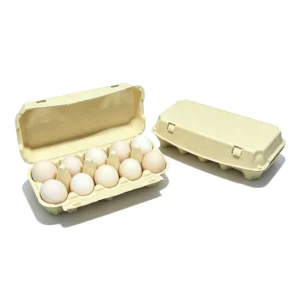
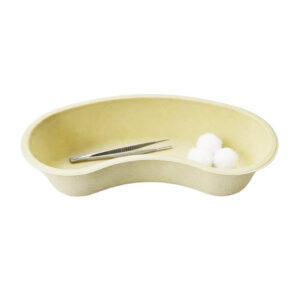
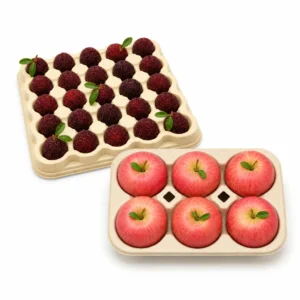

To many people, an egg carton is just an ordinary piece of packaging.
Its role seems very simple: hold eggs, protect eggs, and make transportation easier. But if you look at it from the perspective of food packaging, an egg carton is not that simple at all. Because it stays in long-term direct contact with eggs, it ultimately ends up in supermarkets, in homes, and even on dining tables along with the product. So, for LeadGoal, an egg carton is first and foremost not just an “eco-friendly package,” but a food contact package.
What we care more about is another question: can it truly stand up to the scrutiny of food contact safety?
Recently, the 6-egg and 8-egg trays produced by Hunan LeadGoal New Materials Co., Ltd. underwent a provincial-level product quality supervision and random inspection organized by the Hunan Provincial Administration for Market Regulation. The final result: Passed.
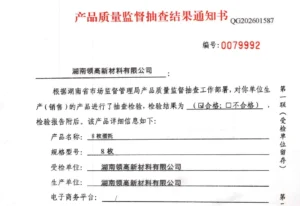
This random inspection was not a self-initiated submission by the company, but was organized and implemented by the Hunan Provincial Administration for Market Regulation, with the inspection category explicitly designated as “provincial-level supervision and random inspection.” Both the inspected entity and the manufacturer were Hunan LeadGoal New Materials Co., Ltd.
For us, the significance of this result is not just having one more report to put in a brochure. More importantly, it gives the words “food contact grade” verifiable data to back them up.
Food packaging cannot be judged by “what material it is” alone
Today, the molded pulp egg cartons on the market use a wide variety of raw materials: bamboo fiber, bagasse (sugarcane pulp), recycled waste paper pulp, and other plant fiber materials.
If we look at them solely from the perspective of “eco-friendliness,” each has its own value. Waste paper pulp addresses the issue of reusing discarded paper resources; bagasse is a way to repurpose agricultural by-products; and bamboo fiber comes from renewable plant resources.
But once we enter the realm of food packaging, the issue cannot stop at “is it an eco-friendly material.”
Food contact safety is not determined directly by the names of materials like “bamboo,” “sugarcane,” or “waste paper,” but jointly determined by raw materials, processes, additives, and final test results.
This random inspection made “food contact grade” concrete
The inspection standards for this 8-egg tray included GB/T 36787-2018 “Pulp molding tableware” and GB 4806.8-2022 “National Food Safety Standard — Food contact paper and paperboard materials and articles”.
The final conclusion: All tested items met the relevant standard requirements, with no non-conforming items found.
| Key Test Items | Standard Requirements | Actual Test Results |
|---|---|---|
| Overall Migration | ≤10 mg/dm² | 0.8 mg/dm² |
| Lead (Pb) | ≤3.0 mg/kg | 0.074 mg/kg |
| Arsenic (As) | ≤1.0 mg/kg | Not detected |
| Formaldehyde | ≤1.0 mg/dm² | Not detected |
| Coliform Bacteria | Not detectable/50 cm² | Not detected/50 cm² |
| Salmonella | Not detectable/50 cm² | Not detected/50 cm² |
An egg carton must also pass the microbiological test
Eggs are a very typical food product. They go from production into packaging, then through warehousing, transportation, supermarket display, and finally to the consumer. Therefore, in addition to the chemical safety of the material itself, the microbiological indicators of the egg carton are equally worthy of attention.
In this test: coliform bacteria were not detected, salmonella was not detected, and the mold test result was below 10 CFU/g, while the standard requirement is below 50 CFU/g. All these results were ultimately judged as qualified.
To a consumer, an egg carton may be just a package they hold for a few seconds. But to a manufacturer, there should be a complete quality control logic behind it.
Why we chose bamboo fiber
Compared to recycled waste paper pulp, bamboo fiber has a very important value for LeadGoal: the raw material path is easier to control from the source.

The advantage of waste paper pulp is obvious — it realizes the reuse of waste paper resources. But at the same time, because the raw material has gone through a previous cycle of use, if it is used for food contact packaging, enterprises typically need to pay more attention to the source of raw materials, historical use factors such as ink and adhesives, and whether the subsequent pulping and purification processes are sufficiently stable.
This does not mean that waste paper pulp is “unsafe.” Rather: if recycled materials are used for food contact, they place higher demands on raw material management and production control. Bagasse, like bamboo fiber, is also a plant fiber resource. High-quality bagasse products can also meet food contact requirements.
So, what LeadGoal really wants to compare with the market is not simply “whose material name sounds more natural.” Before talking about eco-friendliness, get “safety” right first.
In recent years, “replacing plastic with paper,” “plant fiber,” and “degradable packaging” have become increasingly popular. Eco-friendliness is certainly important. It is also the long-term direction of the packaging industry.
But LeadGoal has always believed that food packaging should not neglect its most basic function in the pursuit of eco-friendliness. It must first be safe, and second, stable. Only on this basis can we further discuss eco-friendliness, sustainability, and material innovation.
Therefore, we hope that when customers choose an egg carton, they don’t just ask: “What material is this made of?” They can also ask one more question: “What food contact tests has this product actually undergone?”
Because whether a product is trustworthy should not be judged by promotional language alone. It should be judged by whether it is willing to be verified by standards, tests, and real data.
This time, Hunan LeadGoal’s 8-egg tray passed the provincial-level product quality supervision and random inspection with a passing result. For us, this is not the end. It is proof that we continue to take food contact grade egg cartons seriously.
We hope that in the future, when people mention bamboo fiber egg cartons, they will think not only of “eco-friendliness.” They will also think: it should be safe, verifiable, and a food package worthy of long-term trust.
This is what LeadGoal truly wants to do.